
How to Choose the Right Tennis Racket (and the Five Mistakes Most Players Make)
Walk into any sports shop and you'll see fifty rackets on the wall, all promising more power, more spin, more comfort. Most of the buyers picking one up have no idea what to look for, and the shop assistant has no idea what's in their game. They go home with the wrong tool, fight it for a year, and then blame their backhand.
It doesn't have to be that complicated. Here's the short version of what actually matters when you're choosing a racket — and the five mistakes I see most often after 30+ years of stringing for ITF players and club members alike.
The four specs that matter
Forget the marketing. Forget the colour. The four numbers that change how a racket plays are:
• Static weight — how heavy the racket is in your hand at rest. More weight = more stability and plough-through, but more fatigue.
• Swing weight — how heavy it feels when you swing it. This is the spec marketing forgets to print. It's the one your shoulder cares about most.
• Balance — where the weight sits along the frame. Head-light feels manoeuvrable; head-heavy feels powerful but tiring on long matches.
• Stiffness — how much the frame flexes when it hits the ball. Stiffer = more power, but more shock through the arm.
These four numbers, plus the strings and the tension, are 90% of what makes a racket feel good or bad. Almost everything else is taste.
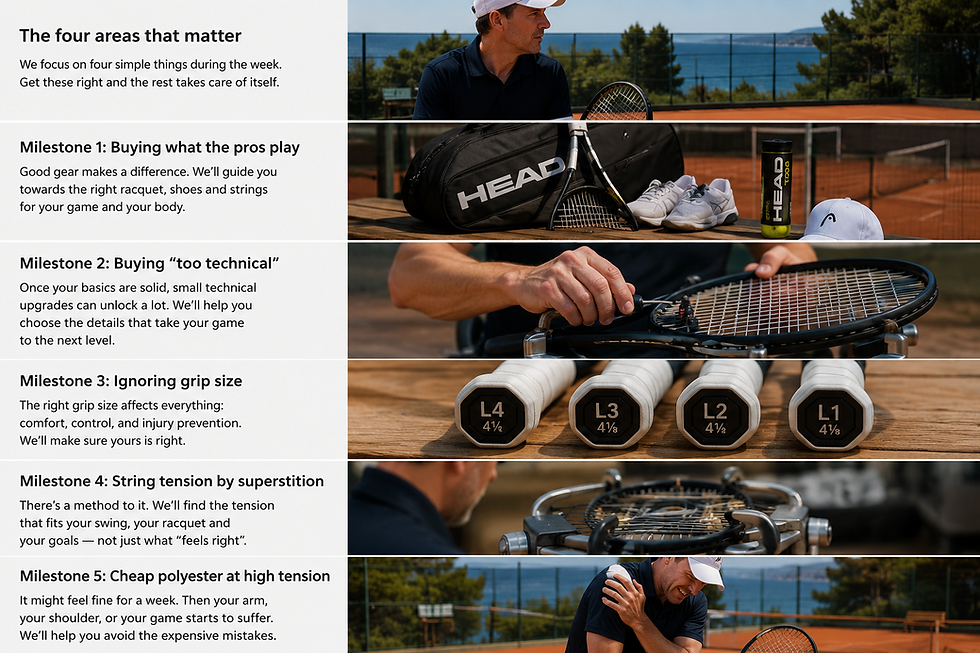
Mistake 1: Buying what the pros play
Federer's RF97 weighs 340g strung. Nadal's racket is built up to over 350g. They have an army of physios and they swing it 200 times a day. You don't. Buying the pro version of a racket because it has the name on it is the single most common mistake we see. Pros pick their setups; their setups don't pick you.
Mistake 2: Buying "too forgiving"
The opposite problem. A lot of intermediate players are sold ultra-light, ultra-stiff rackets with oversized heads on the promise that they'll be easier to hit with. They are — for the first lesson. Then they generate too much power without control, your arm hurts because the frame is stiff, and you blame yourself. A slightly heavier, slightly flexier racket is usually a better long-term partner.
Mistake 3: Ignoring grip size
Most adults play in a grip that's too small. A grip you can't quite reach your fingertip to your palm with is the right size; one your fingers wrap all the way round is too small and forces the wrist to grip harder. Wrist tension is the silent cause of half the elbow pain we see.
Mistake 4: String tension by superstition
"I always string at 25 kilos because that's what I've always done." Tension is not a personality trait — it's a tuning knob. Higher tension = more control, less power, more shock. Lower tension = more power, more comfort, less precision. We adjust by half a kilo at a time and re-test on court. Almost every player we work with ends up at a different number than they came in with.
Mistake 5: Cheap polyester at high tension
This combination is the leading cause of tennis elbow in club players. Hard polyester strings hold tension poorly and transfer a lot of shock; cranking them tight to compensate makes both problems worse. If your arm aches by Tuesday, soften the string before you replace the racket.
A simple shortlist by player type
• Beginners (any age) — 280–295g strung, 100–105 sq in head, mid-flex, multifilament string at low-medium tension. You want forgiveness and comfort; you can buy power later.
• Competitive juniors — weight-step progression matters more than brand. Don't jump straight from a 270g junior racket to a 305g adult one — go through a 290g phase.
• Improving club players — 295–305g strung, 98–100 sq in head, hybrid string (poly mains, multi crosses) at moderate tension. The sweet spot most adult players never realise they should be in.
• Tournament players — 305–320g, 95–98 sq in, full poly or natural gut hybrid. Tested with lead tape rather than bought off the shelf.
The fastest way to actually choose
Hit with two or three demos in the same hour. Same swing, different rackets. You'll feel which one disappears in your hand and which one fights you. Don't trust online reviews — you're not the reviewer. You're you.
That's exactly what our racket consulting sessions are: 60 minutes on court with demos and string options, no upsell, written notes you keep. Most players walk out knowing more about their game than they did walking in.
→ Book a racket consultation in Portorož · We're happy to help over WhatsApp too: +386 41 635 067


Comments